Tuesday, May 1, 2012

Mid-Semester Break

The last week of classes was fairly uneventful since everyone was preparing for finals. After enduring the stressful ordeal of excessive studying, I was pleased to find that the act of taking the exams was much less taxing than the preparation. Sadly, the end of exams meant saying goodbye to Rohan, our Natural Resources Management professor. Siggy (our Rainforest Ecology professor) and Justus (our Environmental Policy and Socioeconomics professor) would stay and become our research advisors for directed research projects and Amanda Freeman would take Rohan's place. We were all sad to see Rohan go, but we knew we would see him again at community night at the end of the semester.
After exams ended we were rewarded with a five-day mid semester break. We were driven to Cairns and then immediately dispersed to catch buses, pick up car rentals and enjoy our freedom. The van we rented was much more comfortable compared to the vans we are accustomed to being jam-packed into so it was a nice change. From Cairns, we drove to Port Douglas with no real plan in mind. After arriving we split up to find a hostel and stumbled upon Parrotfish Lodge. With free internet, a Wii, a pool, a pool table and a ping-pong table all for just $25 a night, we couldn't turn it down. After settling in, we went to explore the beach. It was nice, but we were prohibited from swimming due to the possibility of stingers (jellies).
The majority of the next day we spent exploring the town. It was not very crowded since we were there during the week so it was more pleasant to walk around. The tranquil mood, modest design of the shops and laid-back attire associated with proximity to the beach reminded me of Martha's Vineyard, the island near my hometown which I have visited almost every summer since my childhood. It was a nice little town, but I am not the type to settle in one place for too long.
After spending the second night at Port Douglas we packed up and headed towards Mission Beach. On the way we stopped at a nice overlook and ended up climbing down the rocks to get to the Ocean. The beautifully colored rocks again reminded me of Martha's Vineyard since they resembled the incredible naturally red rocks of Aquinnah. The waves added to the quality of the place and made it ever more tempting to swim in. Inevitably a few of us ignored the danger of stingers and took a quick dip.
Satisfied with our road stop, we hopped back in the van and proceeded on our way. Our next stop was Barron Falls, which I must say trump the Ithaca Gorges that I am accustomed to. The stunning landscape and vast amount of water flow made the sight spectacular. A true tropical waterfall if I've ever seen one. This was probably my favorite view from break.


Our last stop before Mission Beach was Kuranda. We had learned from other students who had visited that it was very much a tourist town; everywhere you looked there were stores selling the t-shirts, boomerangs, postcards and aboriginal art. It was comparable to Cairns in how congested it was with shops. They had a few other attractions like birdworld, butterfly sanctuary, koala gardens and even a venom zoo. We browsed the shops playing tourist unashamed and I broke down and finally bought a boomerang.


We then went to yet another Fan Palm Forest. The experience was even better the second time due to perfect weather. I was hoping to see a Cassowary again, but no such luck. Regardless, the forest was absolutely stunning and had the effect of making me once again feel like I was walking in a prehistoric era.


After all those stops, we finally made it to Mission Beach and immediately found a hostel called absolute backpackers. So we parked and checked in and then prepared for the beach. Unlike Port Douglas, there were operational stinger nets so we were permitted to swim, and swim we did. The surfing was alright, but mostly it just felt nice to be able to swim in the ocean again. During the semester the only place we are ever able to swim is at Lake Eacham, a crater lake near the Centre for Rainforest Studies. Though freshwater is nice, nothing compares to the wild, temperamental  water of the sea.


The following day, Will decided to go Skydiving. Though I am generally up for anything, skydiving is on my list of things I will never do, mostly because I hate planes not because I am scared of falling. Hang-gliding is definitely something I would do. For either lack of interest or monetary reasons, the rest of us decided to let him have the glory of being the only one to skydive over the Great Barrier Reef. Greg and I went to watch and take pictures from the Beach while the others stayed at the hostel. As we were waiting, a dog with a collar but no apparent owner approached us. Her name was Lola according to the tag and she was quite interested in my boomerang. This made it slightly difficult to practice throwing it since she was constantly trying to steal it so we had to distract her with pieces of driftwood or whatever we could find.

Once we saw Will we abandoned boomerang-throwing practice and immediately went into action photographing and filming his descent. Luckily, his bright yellow shorts made it easy to distinguish him from the others. Seeing his expression after landing, you could tell that the experience was breathtaking. You could not ask for a better view than the coast of Australia for your first skydiving trip and if I ever were to skydive I would probably do so there.


Saturday, March 24, 2012

Casso-what?


We had class Saturday morning so we did not arrive in Cairns until after 4. As usual, most of the store closed early, but there were a few still open. After addressing my most critical need (acquiring a pizza at Dominos) I wandered around and stumbled upon the Night Market. Perhaps the most lively venue within an 100-mile radius, but I wouldn't say it was bustling with activity. The store to customer ratio barely exceeded 1:1, not that I'm complaining about the lack of crowding. Many of the stores were clearly meant for tourists, but they also had numerous food stands and rows of massage booths. I had never seen so many consecutive massage booths in one place before, and was not really sure what the need was. I had never perceived Australians to be particularly stressed, but perhaps living in close proximity to so many dangerous creatures has made massage stands a necessity.


I browsed about the rest of the Night Market, acquiring souvenirs and taking in the culture. The shopkeepers were all quite nice and willing to help customers when asked. What I liked most about the shops, however, was that they allowed themselves to be confronted by the customers instead of vice versa. One of my biggest pet peeves is to not ask a shopper if they need help, especially if it is clear that they are just browsing. It makes it much more awkward when you don't buy anything, which for me is often the case. I did end up buying a few things this time, however, and I returned to the hostel content with my purchases.
Since it was St. Patrick's we partied hard that night. Some stayed at the hostel while a few of us hit up the bars. My pledge to speak in an Irish accent for the entirety of the day failed. Despite the fact that I am half Irish, there is really nothing Irish about me, except maybe alcohol tolerance (knock on wood for that). After a long night out, I got back to the hostel around 2:30 or 3:00, I can't remember when exactly.
The following day we ventured to the Cairns Tropical Zoo. I will take a moment now to vent my opinion of zoos. I am opposed to the idea of animals being kept behind bars under any circumstances unless there is no chance of them surviving in the wild (due to injury or the like). As for captive breeding, I am still undecided.  I figure if the animal was never exposed to the native habitat of its species then living in an enclosure with ample space and suitable living conditions would not be such a bad life. I still believe that a lot of zoos put profit over comfortableness of the animals, which is a problem. The ideal zoo for me would be one in which the natural settings of the animal's habitat are replicated as closely as possible, which includes how they are fed. Food should be positioned in such a way to create a challenge to the animal, to stimulate its natural instincts and prevent boredom. When such features are incorporated into zoos, the animals will not only be happier, but will act more like the wild animals they are made to represent.
The Cairns Tropical Zoo was not my ideal zoo, but it was worth going to nonetheless. It was here where I had the realization that the large animal I saw in the Daintree was in fact a Cassowary. The main reason I doubted this in the first place is because I was expecting the Cassowary to be much larger than it actually was. It was still impressively sized, but on a par with Emus, perhaps a little shorter. Perhaps my excitement of over my realization that I'd seen a wild Cassowary may have caused me to have a biased view of the zoo due to my elevated mood.
In addition to having a Cassowary practically right in front of the entrance, the zoo had a couple Dingoes (which were in separate pens since they seemed to be amidst a power struggle), an adorable Red Panda, Cotton-Top Tamarins, Sugar Gliders, Hairy-nosed Wombats, heaps of Koalas (one of which we got to hold), Kookaburras, Eclectus Parrots, some really cool-looking venomous snakes and the largest Crocodile I have ever seen.
A few of the interactive exhibits included a walk-in Kangaroo exhibit and Wallaby exhibit. It was here that we could walk right up to the herd of kangaroos and start petting them, which was quite an interesting experience. I came to Australia fully expecting to see kangaroos but had never thought I'd get the chance to be able to pet one. After all, they can be quite aggressive (you would NEVER want to challenge a kangaroo to a boxing match!).


One interactive exhibit featured animals not native to Australia, rather a well known species from a country on the East side of Africa: the Ring-tailed Lemur. At the start of the day we signed up to participate in the lemur tour. There were just enough spaces so that Nicole, Katie, Carly, Zoe, Bridget and I all got to go in as our own group. It was here that Nicole accomplished one of her dreams: to feed these amazing primates. It is too bad that SFS does not also have a program in Madagascar, since the wildlife there is also spectacular. There were four lemurs in all, and they all came down temporarily to grab the food from our hands and let us take pictures of them. They were incredibly gentle, though I'm sure that their bite is powerful when necessary. They are beautiful animals whose populations are unfortunately much more abundant in zoos than in their native wild habitat. Perhaps there is something to be said of zoos since they do in fact keep species alive so that generations from now people will still be able to watch them in awe.
 
Such was our day at the zoo. I saw a Cassowary up close and personal, Nicole got to feed her favorite animal and Katie was able to see Sugar Gliders. As we waited for our bus back, I thought about how other people's days had been. Another group of us had gone on the Passions Reef Cruise, though the weather was less than ideal (it was raining all day). Apparently the waves made it less enjoyable and there were a number of jellyfish in the water so the snorkeling was not so fun. I hope that next time they will have better weather so that they will have more fun experiencing what I consider to be one of the most diverse ecosystems of our planet. My next Cairns weekend I plan to tour the Frankland Islands, which are known for giving visitors a chance to see baby sea turtles hatching on shore and migrating to the ocean.
But that is getting ahead of myself, our next Cairn's weekend is not for awhile (though we will be returning to Cairns temporarily for spring break). After getting back from the zoo, we returned to the esplanade, and the interns and student affairs manager greeted us with Domino's Pizza (which further elevated my mood). We got back to Yungaburra fairly late and right away starting working on our field notebooks which were due the following morning (sleep was neglected that night).

The following week was our last week of classes. It started off with an exciting flash flood. Monday afternoon we experienced torrential rains that lasted for hours. The water in the classroom accumulated to nearly two inches in just a matter of minutes. Shoes left outside were being swept away. Trees were falling and the access road endured considerable damage that rendered it impassable for a few days afterwards. Despite how it may sound like I'm portraying it, the flood was incredibly fun. We went and played volleyball in the rain, sloshed about in gum boats and got completely soaked. The only annoying part of it was having to clean up the following morning. It was well worth it though, and I would love for it to happen again.


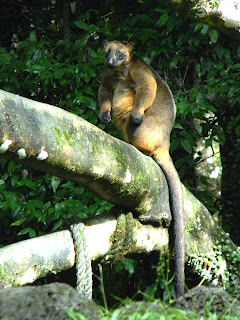
The following day we had our field trip to the Lumholtz Lodge, where we got to hold pademelons in our laps and pet a Lumholtz Tree-Kangaroo. The fearless woman who owned the place fed wild pademelons which she let run about in her house. When she saw the Tree-Kangaroo (Jeffrey) come up to the window pane, she went outside and let him jump on her back so she could carry it inside. She put him in a side room where she fed him and then allowed us to enter in small groups. Since he was so intent on its food, he did not mind us petting him. She told us a lot about her experiences dealing with Tree-Kangaroos and how aggressive they can be. She wouldn't dare try and remove Jeffrey from her shoulders for the risk that he would act defensively and sink his sharp teeth into her arms if she tried. Instead she must wait for him to get off at his own will. Though he comes into feed, he is still a wild animal. Seeing Tree-Kangaroo so closely, I can really see just how remarkable they are. They are able to hop and climb, a bonus to being able to escape predators. They are most distinctive for their impressively long tails, which they use for balance. Unrelated small world moment: I ran into the Lumholtz Lodge owner's sister at the Crystal Caves shop in Atherton. Australia never fails to surprise me.

Friday, March 16, 2012

Daintree (Forest and Sea)


Ever since I have heard of Cassowaries I have wanted to see one. Cassowaries are giant flightless birds that have inhabited Australia since it was part of Gondwana, the Southern Supercontinent superseding Australia's independence from any mainland. They are nearly the size of Ostriches and look as prehistoric as they are. They have huge Velociraptor-like claws and a crest that looks like it could have been stolen from the armor of a Stegosaurus. They look fierce enough that they could have beaten up on dinosaurs and very well could have if  their time on earth had overlapped with their featherless ancestors. Unfortunately they were less prepared for the animal whose existence does overlap with theirs: Homo sapiens. Extensive logging of the lowland rainforests have led to substantial declines in the Cassowary's population. Furthermore, Cassowaries are a keystone species due to their role as a seed disperser of large fruit. There are numerous trees and plants whose seeds require passage through the Cassowary's digestive system in order to germinate It is not impossible for these trees to reproduce in the absence of Cassowaries, but the rate of successful germination does drop significantly. Thus there has been a huge amount of effort to restore their population in recent years for the sake of their intrinsic importance as well as for the sake of the Wet Tropics lowland rainforests. You can see why I was so anxious to see one.

The Daintree is one of the best places to see a wild Cassowary. Just last year, a group of SFS students saw a father with three chicks (it is the male that endures the grueling task of parenting). And so optimistically prepared myself to see one. Before arriving at our campground we stopped at a beautiful type 1A forest where we hiked, walked the suspension bridge and then swam and enjoyed smoko (Aussie slang for tea/snack time) by the stream. 


Metallic Starlings
From here we completed our journey to the Crocodylus lodge (our Daintree headquarters) where we unpacked and hung out until dinner. Nothing much happened after dinner so I'll just skip to the following day. We started it off by going on a trip to the Daintree Discovery Centre where we walked up the canopy tower for a better view of the reserve. It was here that I saw a flock of Metallic Starlings that had built elaborate nests that hung from branches. In the information centre, they had several Jungle Carpet Pythons, a Boyd's Forest Dragon and life-size models of Cassowaries. And on the Cassowary Circuit we saw a Cassowary Satin-Ash and a 
Cassowary Plum, but no real-life Cassowaries.

After the Discovery Centre we finally got to see our Tropical Field Ecology Professor's infamous Daintree Jungle House. Almost every lecture she mentions some spectacular animal sighting she'd seen from her veranda, so we were anxious to finally get to see what she was referring to. We were greeted by her husband who does a lot of research on Wild boars, an invasive species that has caused damage to rainforests. He gave us a tour and showed us how they managed to live sustainably by treating and using rainwater, using a compostable toilet and installing a solar cell above the forest canopy. When I return home I may suggest installing a solar cell at our house above the pine trees, since my dad is always complaining that the shade inhibits the power-generating ability of our attic and greenhouse and threatens to chop the heads off of them. I always retort by saying the decreased sequestration rates in the pines would defeat the attempt to reduce our carbon footprint by increasing light penetration to our greenhouse, though I'm not exactly sure how one would go about proving that.

After exploring our professor's awesome house, we hopped in the vans and arrived at the Palm forest, which was by far my favorite forest type of the ones we have seen so far. The palms were as large as boulders, four or more feet across. I truly felt like I was experiencing the world of the dinosaurs as I traipsed my way under the massive fronds. It was by far my favorite of all the forests we have seen. 


After the Palm Forest we picnicked at Cape Tribulation, which as publicized is where the Forest meets the Ocean. It was beautiful to behold. The stereotypical paradise of white sand and coconut trees was not an inaccurate description of the beach. There was even a nearby forested Island that sat tantalizingly close to our beach, but unfortunately we were banned from swimming due to the risk of Jellies. Nonetheless we had fun just wandering about, munching on coconut and playing beach rugby.


Our last destination of the day was the mangrove swamp. Subject to constant flooding, the trees were designed for inundation. When tropical cyclones hit, the water level can rise several feet. The complex root systems of the trees allowed for stability and greater Oxygen uptake during these seasonal periods of inundation. So we saw some unique landscapes, but alas, still no Cassowaries.


Last day. I'm becoming angsty about losing my opportunity to see a Cassowary. In desperation, I go on an early morning hike to see if I cannot find one. I do not get too far down the trail before I see something very large running through the trees. I then see something much smaller running not too far away from it. This is where my curiosity and excitement outweigh my common sense and I sprint towards what I perceived to be a Cassowary with at least one chick. I catch up to the chick only to find that it is just an Orange-footed Scrubfowl and by the time I realize this, the larger animal had bolted. I continue calmly down the trail and notice a multitude of boar tracks. It is this observation that forces me to accept the fact that the large animal I witnessed was most likely a Wild Boar and not a Cassowary. I continue around the loop anyway, which turned out to be much longer than I expected. I finally make it back to camp, disappointed and frustrated. I shove down my breakfast since everyone else had eaten by that point.
My frustration did not last long because we were scheduled to go on a river cruise to see one of the coolest reptiles on the face of the Earth: the Saltwater Crocodile. We all filtered into a windowless cruiser and drifted out into saline water in pursuit of these ancient beasts. Right away we saw a few small two to three-year old crocs on a bank. As we went we were told us to look for newborns and we did see a few swimming about in the mangroves. This was all fine and well, but I wanted to see one that had the potential to rip my arm off if I got too close. Our tour guide warned us that Liz (the mother of the newborns) usually stayed close to them, but he hadn't seen her over the past few days. Thinking that this was just my luck, my excitement level dropped for awhile until a tour guide from another boat told us that he had just seen Liz on the shore close by, and indeed she was still there when we got there. A remarkable 8-foot-long beast, she was amazing to view. Though tolerant of us being there, I could tell that she could easily take down any one of us if given the chance. Crocodiles, I am convinced, are of the toughest species in the world. I still don't know how Steve Irwin, or anyone for that matter ever could have managed to wrestle such a magnificent creature.


Sunday, March 4, 2012

Adventures Down Under... the Sea

During the semester we are given several free weekends in Cairns, the nearest major city. This means we are dropped off on the Cairns esplanade and left to ourselves while the staff 'disappear' with the vans. And so we arrived in Cairns on Saturday afternoon, excited to explore the city. We quickly discovered that hardly anything is open after 2. We wanted to go biking but every bike shop was closed. Just as we were about to give up, we stumbled upon a bike and scooter shop that was open until five. It was 3 when we got there, but we were happy to at least get in a two-hour bike ride. So we biked to the Botanical Gardens, which of course were also closed, but the outskirts of the gardens were worth seeing. And the struggle to balance on the tandem bike kept us all entertained as we either watched or participated in the difficult task of keeping the bike upright and mobile over bumps and around sharp turns (we took turns to reduce the burden). An exciting first adventure, but we would have many more.
That night I walked to Dominos just as I do almost every night back in Ithaca. Pizza without tomato sauce is actually the staple of my diet back home, so I was quite pleased to find that Cairns had one of my favorite pizza joints. I quickly ate my three quarters of pizza and then delivered the rest of the order back to my roommates at the hostel. From there I headed to the free dinner I didn't need at the Woolshed Pub and met up with the rest of the SFS crew. We stayed about an hour and then headed to the Reef Casino, which like most venues in Australia was extremely expensive. One round of black jack cost $20. Since I had given myself a $20 gambling limit, I chose to forego card games. Instead I decided to try my luck at Roulette, but lost $10. I managed to gain some money back at the slot machines, but did not leave with a profit. So we went back to the bar and hung there until midnight, then went back to the hostel to prepare to get up at the crack of dawn for the reef trip.

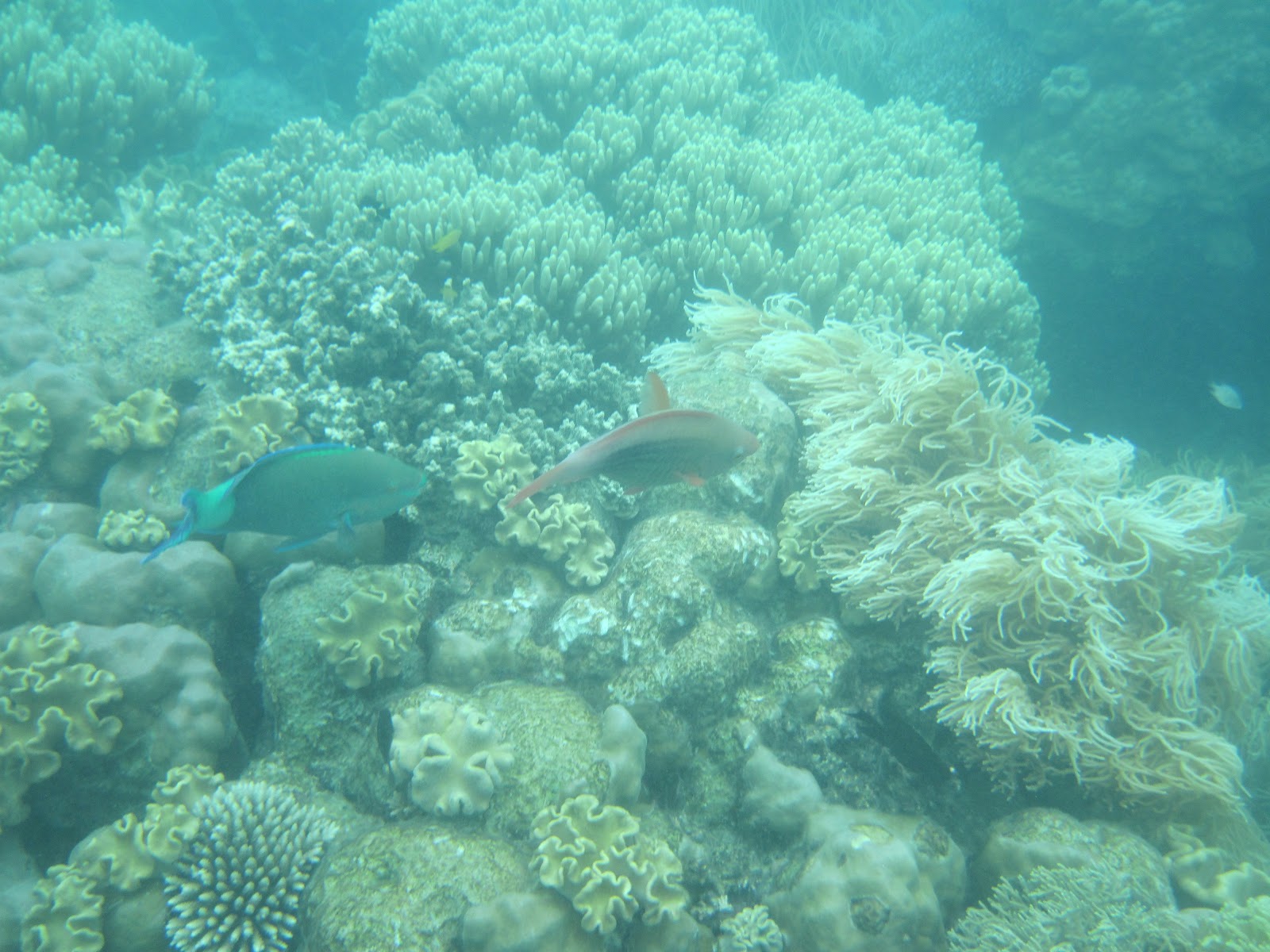
7:30 was when we had to be on our boat for the "Passion Cruise" tour. And so we lugged our stuff down the stairs, checked out of the hostel and trekked our way back to the esplanade, where we boarded. We were given the regular safety briefing and then slept/looked out to the sea as the boat carried us away towards the reef. The arrival was abrupt, I was half expecting to be able to see the Reef from the boat since it is apparently large enough to be seen from outer space. Regardless as soon as I got in I was astounded by what I saw. Immediately I was greeted by several species of fish that almost seemed to pose for pictures as I swam up next to them with my underwater camera that I bought specifically for this trip. I dove down to get a closer look at the coral and could hear the fish pecking at it. I even encountered a stingray and watched it dig into the ground with swift, undulating motions.


At our second stop, there was a nearby island, called Michaelmas Cay which had a small beach marked off with roped fence. The fine for walking outside the fence was apparently 10,000 dollars (it seems that Australia gets away with overpricing everything, including fines). Determined not to be fined, I was careful not to surface myself anywhere outside the ropes as I made my way up the sand. I did not spend long on the Island though, since there was much more to be seen underwater. There was no need for a swimming break anyway since the high salinity of the water made it easy to just float and watch everything underneath you. When the time came to reboard the boat, I was reluctant to leave. I wanted to capture everything on camera for fear that the reef would not retain its same beauty even until next year as it succumbs to coral bleaching. One of the biggest factors in my decision to study abroad in Australia was so that I could see the Great Barrier Reef before it perishes.


Giant Clam

Ashley and Keaton
Katie

Sea Anemone


Friday, February 24, 2012

Every Day I'm Wanderin

View of Thiaki Creek Rainforest
This week involved a lot of time in the field and work spent writing the paper for "Principles of Forest Management". We spent long hours hiking around in the brush at Thiaki Creek Rainforest, measuring the trunk width and height and determining the mortality rate of trees planted by TREAT several years ago. For my project I compared our data with data taken from the Dry Season (back in September) and found that the trees that exhibited higher vertical growth rates and diametrical growth rates at the base of the trunk were destined to be high canopy trees while those that exhibited higher diametrical growth rates around the trunk at 30 cm height were understory and sub-canopy species. The most shocking realization to me was that I actually could and did correctly determine which species would become canopy trees when I looked them up, all based on which of the growth rates a species tended towards (nerd moment, had to do it).

Setting up the plots
Scoping out the landscape
Unfortunately I had to pull an all-nighter to finish the paper, perhaps in part due to our 2 hour and 15 minute hike on Sunday. It was kind of a spur of the moment idea that led Greg, Rob and I to wander off in pursuit of the infamous Cathedral Fig. So we set off, traipsing across pastures and the old access road until we hit the main road. From there we walked about a mile and a half before we stumbled upon the sign announcing our arrival at the tree. 


Amazing large and incredibly tempting to climb, the Cathedral Fig truly inspired awe, not just because of its great size but also because of its beauty. We gaped at it for a few minutes before realizing that we could even go inside. I've walked through Sequoia trees, but standing in the Cathedral Fig may trump that experience. Just looking up you can tell that this one tree is its own ecosystem, with all its symbionts making up dense foliage at the top and from the mosaic of vine-like branches that would make it an ideal home or resting area for animals looking to evade predators. My picture does not do it justice. After admiring the Cathedral Fig for a good 20 minutes, we headed back and made it just in time for dinner and long before our TA (I know that's not his actual title, but I can't think what else to call him) had predicted. A well-worth-it journey I would say.


A Hercules Beetle that keeps me company as I write papers

As promised, a picture of a Carpet Python